-------------------------------------------------------------------------------------

(WARNING SPOILERS)
With Inception still blazing a trail through the multiplexes, Christopher Nolan continues to prove himself as possibly the finest big-budget auteur in contemporary cinema. Yet, while each of his films are very much their own unique product (from the head-scrambling Memento to the superhero outings of Batman Begins and The Dark Knight), you'd never mistake them being from any other director. Dark, moody, potentially glacial, but always fiendishly clever, Nolan is arguably also the most successful contemporary director at mining a wonderfully rich, literary quality in his films. The Gothic; the consciousness; guilt...it's all there. But the main, all consuming theme is time...and not just the passage of it, but how filmmakers can manipulate it for their own ends on a metafictional level, bamboozling the audience, playing with their expectations.
Take into consideration The Prestige, a typically (and thrillingly) intricate effort based on Christopher Priest’s novel, ostensibly focusing on the rivalry between two magicians in nineteenth century London. Hugh Jackman and Christian Bale are brilliantly cast as the opposing illusionists, pitted both at the ends of the social scale and in terms of technique. Jackman's aristocratic Angier is the inferior magician but the greater showman, relying on props man, Cutter (Michael Caine) to bring his shows to life. Blaming Bale's lowlier, but more natural conjurer, Borden, for the death of his wife on-stage, Angier's life becomes consumed with the search for the perfect magic trick, the secret to which Borden appears to have hidden in a cipher in his diary.

Of course, Nolan expects more work from his audience than that, playing around with the temporal span of events to magnificent effect. The film actually begins with a bewitching shot of seemingly abandoned top hats in a snowy outdoor environment, before Bale's character intones those attention-grabbing words: 'Are you watching closely?' We then cut to the next scene, where Borden, back-stage during what is reputed to be Angier's final, land-mark show, appears to see his rival drown inside a water-tank. It therefore not only lays out the tricky narrative thrust of the film; it's a subliminal challenge to the audience, asking them to keep up if they want their attention to be rewarded in the long run (which it most certainly is).

Blink and miss it, and the film will likely turn into even more of a slog. From there, it leads us on a terrifically labyrinthine, treacherous journey, complete with more double-crosses, identity switches and red herrings than one can shake a white rabbit at. However, the biggest leap of faith (anticipating Inception) comes when Angier travels to America to meet the famed Nikola Tesla (David Bowie), whose apparent teleporter is the set-up for the film’s climactic curveball, an explicit leap into sci-fi territory.

Make no bones about it; beautifully shot (by Wally Pfister), immaculately designed (by Nathan Crowley) and superbly acted though it is, the real star of the film is Nolan himself. Transcending the already gripping period thriller trappings, an era when, for instance, the manipulation of electricity becomes crucial to the plot, the film becomes not only an intoxicating one, but a film about storytelling in its own right, about how the chronological span of events can be twisted not only to suit the needs of suspense...but also to subvert the expectations of its audience. Like Guy Pearce suffering with short-term memory loss in Memento, it works like a magic trick itself, forcing us to replay events in our head and stitch them all together, ideally through repeat viewings.
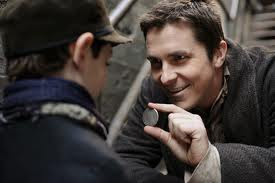 The most wonderful part of all this skullduggery is the reaction it provokes at the climax, the culmination of all Nolan's subliminal challenges throughout the movie. It's been set-up from the start, both in the classic three act trick structure laid out by Cutter (the pledge/the turn/the prestige) and in that bewildering 10 second opening salvo. The horrifying extent to which Angier goes in exploiting Tesla’s machine is borne out in the almost subliminal last shot of the film, where Borden casts his eye over dozens more tanks, each filled with dead Angier’s who have been cloned through the machine and then drowned at the culmination of each of his magic acts. It’s a wonderful bamboozle not because it provides a twist…but because it provides exactly the ending eagle-eyed viewers will have seen coming a mile off, yet won’t want to accept precisely because of its seeming ludicrousness. It’s a brilliantly subversive coup, transforming a gripping story about magic into a much cleverer, metaphorical one about how audience expectations are manipulated through the magical, time-stretching duration of cinema itself.
As Cutter himself gravely intones: ‘You want to be…
…fooled'


